DJ Ape .Net – The Home of Perfect Sudoku


NEW! Coming soon...
Monthly newsletter
Subscribe now to get
discount codes for my books!


CalcuDoku aka SquareWisdom puzzles from Djape
we do syndicate puzzles
to newspapers and magazines.
daily newspapers get 6 months FREE!
interested?
send us an e-mail!


Sudoku K available worldwide!


January 27, 2010

Jigsaw+Classic Sudoku combination

Filed under: Sample puzzles, jigsaw sudoku — djape @ 12:26 am

Today’s puzzle on the Daily Sudoku page is somewhat ambiguous. This is why I’m duplicating it here on the main page.

Basically, it’s a Classic and Jigsaw Sudoku combination. In addition to 9 Jigsaw nonets, there are 9 classic Sudoku nonets too. You have to use them both in order to solve the puzzle. Since it’s first of its kind, it’s rather easy, but give it a go to see how you like them.

By the way, a few of these can be found in the Jigsaw Sudoku book volume 2.

Jigsaw+Classic Sudoku combination for Tuesday, January 26, 2010 – Difficulty: EASY.


The solution is here

January 14, 2010

OddEven Jigsaw Samurai Sudoku

Filed under: Overlapping Puzzles, Sample puzzles, Samurai sudoku, jigsaw sudoku — djape @ 3:24 pm

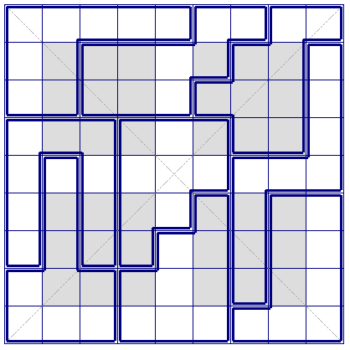
It’s been a while since I last posted a Samurai Sudoku variant puzzle. Here is a new one. As far as I remember, I never posted such puzzle before.

Remember: shaded cells MUST contain only ODD numbers!

OddEven Jigsaw Samurai Sudoku for Thursday, January 14, 2010 – Difficulty: COOL.


Pdf version is here. PNG solution is here.

January 11, 2010

Outside Jigsaw Sudoku

Filed under: Outside Sudoku, Sample puzzles, jigsaw sudoku — djape @ 1:10 pm

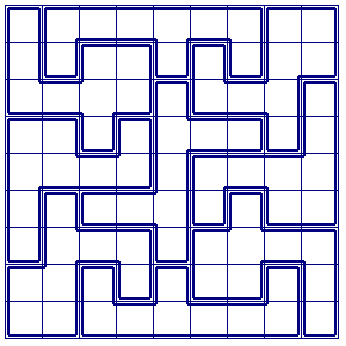
Another novelty in 2010 – Outside Jigsaw Sudoku. Read the rules of Outside Sudoku first. And then, twist it a little – it’s a Jigsaw (Irregular) Sudoku puzzle!

UPDATE: One clarification about the rules of Outside Jigsaw Sudokus: The clues tell you which numbers appear in the 3 closest cells in that row/column. They are not linked to (jigsaw) nonets. Oh, and I’ve posted the solution.

Outside Jigsaw Sudoku for Monday, January 11, 2010 – Difficulty: BRAIN.


The solution is here

December 11, 2009

ZERO Killer Sudoku, Killer Samurai 3 and Jigsaw Sudoku 2 on Amazon

Filed under: General, Samurai sudoku, jigsaw sudoku, syndication — djape @ 1:50 am

Here is a Christmas gift for you! Just in time for the holiday season, three new books have been published on Amazon:

  • First ever Zero Killer Sudoku: 101 puzzles – Maximum Challenge
  • Killer Samurai Sudoku vol. 3
  • Jigsaw Sudoku 160 very twisted puzzles volume 2
  • That’s right, I listened to your requests and have prepared a book full of only ZERO Killers and nothing else!

    These books will NOT be published through LuLu!

    This should take you through the holiday season. :)

    January 15, 2009

    Jigsaw Sudoku, Sudoku X and Classic Sudoku books available for download from LuLu!

    Filed under: General, jigsaw sudoku, syndication — djape @ 8:53 pm

    A few of you requested these books be made available from LuLu. So here they are!

    PDF e-book from DJAPE PDF e-book from DJAPE PDF e-book from DJAPE
    US $5.95 US $5.95 US $4.95

    December 29, 2008

    Happy New Year!

    Filed under: General, hanjie (griddlers), hidoku, jigsaw sudoku — djape @ 2:36 pm

    I hope you all had a nice Christmas and that you are enduring the cold weather well. Well, those in the Northern hemisphere anyway. :)

    Let me tell you about the changes that I plan for 2009:

  • There will be more Jigsaw Sudoku puzzles on the Daily Sudoku page. They will be accompanied by the Sudoku Straights puzzles, which is something new, but I think you should learn. There will be fewer (non)consecutive puzzles – it seems they’ve gone out of fashion.
  • The “Download” page with Perfect Sudoku v0.4 is gone. That software is more than 3 years old and is way outdated. For the time being, I do not intend to release a newer version.
  • There will be a new page with daily puzzles! In fact, as of tomorrow, you will be able to download Daily Hidoku puzzles from this site! For those unfamiliar with Hidoku, check this category.
  • I intend to start creating more puzzle types: Hitori and Nurikabe are next in the queue! Stay tuned for updates.
  • I intend to publish a number of new books as well as new volumes of the old ones. Very soon a Picross (Hanjie, Griddlers, Nonograms) book is coming, followed by new volumes of the “Revenge”, Samurai, Hidoku and KenDoku. I’ll keep you posted.

    That’s it for now. Have a great New Year’s Eve! Best wishes!

    UPDATE: Sorry folks, for various reasons, I will start posting the daily Hidoku puzzles from around the 15th of January.

  • December 5, 2008

    3 new books: Classic Sudoku, Diagonal Sudoku and Jigsaw Sudoku!

    Filed under: General, jigsaw sudoku, syndication — djape @ 10:00 pm

    After so many different Sudoku variations and other puzzle books, it is time to present you something more ordinary, but of the top quality. Three brand new books that are available on Amazon and Lulu NOW!

  • Djape does Sudoku: 300 puzzles for advanced solvers
  • Diagonal Sudoku: 200 puzzles with an X
  • Jigsaw Sudoku: 150 very twisted puzzles
  • PDF e-book from DJAPE PDF e-book from DJAPE PDF e-book from DJAPE
    US $5.95 US $5.95 US $4.95


    These books, along with the previous ones, should take you through the holiday season. :) But rest assured there are more coming in January!

    August 24, 2007

    The Law of Leftovers (LOL)

    Filed under: Solving tips, jigsaw sudoku — djape @ 1:25 pm

    I promised to explain this technique, which applies to Jigsaw (aka irregular blocks) puzzles, a while ago, so it’s time to keep the promise. You can find the same technique explained on various other sites, too.

    This technique is somewhat similar to innies/outies which is used for solving Killer Sudoku puzzles, but there is no math involved and, again, it applies to Jigsaw Sudokus (and variations thereof).

    First, I’ll explain some terminology that will be used:

    LOL can be applied to any number of either rows or columns. How many rows you will use, it’s up to you (depending on the puzzle you are solving). The rows you are using must be adjacent to each other and they can start from the middle. In other words, they can, but don’t have to, be aligned to the edge of the puzzle. The adjacent rows (columns) that you choose to apply LOL, we will call AREA.

    Some jigsaw nonets will be completely outside your chosen area, some will be completely inside it and some will have cells both inside and outside your area. Focus on nonets that have cells both inside and outside the area. We’ll call them BROKEN NONETS.

    INNIES are cells that are within the area and belong to broken nonets which have fewer cells inside the area than outside of it.

    OUTIES are cells that are outside the area and belong to broken nonets which have fewers cells outside the area than inside it.

    Ok, this sounds quite confusing. So here is a sample puzzle to make it clear:
    Jigsaw Sudoku - Law of Leftovers - www.djape.net

    By using the common Sudoku solving techniques, you should reach this position:
    Jigsaw Sudoku - Law of Leftovers - www.djape.net

    Now what? Look at the first 3 columns. This will be your area. It is outlined in red in this picture:
    Jigsaw Sudoku - Law of Leftovers - www.djape.net

    If you are paying attention, you will already know why are some cells outlined in green. They are innies and outies. If you are not sure why, read the definition of innies and outies again!

    IMPORTANT: The number of innies must always be equal to the number of outies. If your number of innies doesn’t match to your outies, you’ve done something wrong. Go back and look at it again!

    Finally, it is time to state The Law of Leftovers:

    The set of numbers in innies must be the same as the set of numbers in outies.

    Why? Because in your area, which consists of “N” rows, there must be precisely “N” occurences of each digit (1-9 in normal Sudoku case). This is always the case in any Sudoku puzzle. Also, any “N” nonets contain precisely “N” times each digit (1-9). Now, jigsaw nonets that are broken by this area, “borrow” (or “lend”, depends how you look at it) some of their numbers from the rest of the puzzle. Those are innies and outies. In order to keep the puzzle consistent, those numbers that are borrowed must be the same as the numbers that are lent.

    Anyway, lets apply LOL to our sample puzzle. Our 3 innies have these candidate numbers (some of them are naked singles, but it doesn’t matter): 7, 2 and 3|9. Our 3 outies can be: 2|8|9, 2|8 and 7. So, number 3 is a candidate in innies, but it’s not a candidate in outies. According to the Law of Leftovers, this cannot be! Therefore, we can eliminate 3 from the list of candidates in innies. Accordingly, we can eliminate 8 from outies (because it does not appear in the list of candidates for innies). There you go! We have solved two cells: R3C4=2 and R8C3=9.

    From here, this puzzle can be solved by using the usual techniques. Here is the final solution.

    Obviously, LOL can be applied to Jigsaw overlapping puzzles (Samurai, TwoDoku and any other) as well, using the same approach.

    Next Page »